
Understanding Alkalinity In Your Pool
Everything You Need To Know About Pool Alkalinity
Has your pool water turned cloudy? Or have you noticed scaling on the sides of your spa or pool? These can be signs that your pool water balance is off. We understand that keeping all the chemicals in your pool balanced can feel tricky, especially when pH and alkalinity levels can shift due to rain, debris, lotions, oils and heavy pool use. But maintaining the right pool chemistry is essential for keeping your water clean, safe and comfortable to swim in. So, let’s break down everything you need to know about alkalinity in your pool.

- Last Modified May 14, 2026
Key Takeaways
- Total alkalinity helps stabilise your pool water and acts as a buffer that keeps pH from changing too quickly.
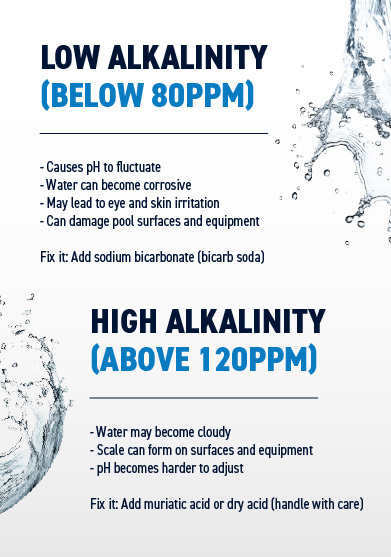
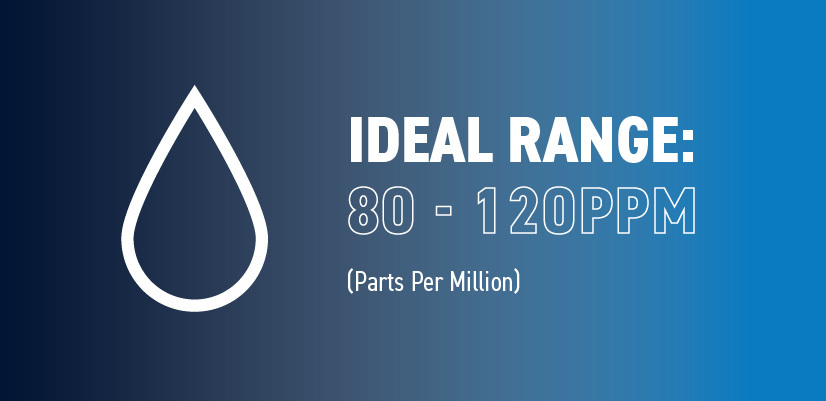
- The recommended alkalinity range for most pools is 80 to 120 ppm, and levels outside that range can lead to cloudy water, scaling, corrosion and swimmer discomfort.
- Alkalinity and pH are closely connected, but they are not the same thing and should be tested and managed separately.
- Low alkalinity can usually be corrected with sodium bicarbonate, while high alkalinity is typically lowered with dry acid or sodium bisulfate.
- Regular testing, especially after rain, heavy use or topping up the pool, is one of the best ways to keep your pool water balanced and healthy.
What Causes Low Or High Alkalinity In My Pool?
Causes For Low Alkalinity
Excess urine and perspiration in the pool water can bring the alkaline levels of your pool down. Another common reason is when your pool water gets flooded with rainwater due to a heavy downpour. Using chlorine tablets in excess is also said to cause a drop in the alkalinity levels as they contain a low pH level. Lastly, use of too much dry acid can have a negative impact on your pool water.
Causes For High Alkalinity
There are three main reasons behind high alkalinity levels of your pool. Firstly, when the oil, sunblock or lotion you use during a swim get mixed into the water. Secondly, if your pool water source has a high alkaline content. Lastly, some pool owners may shock their pool too often after hosting a pool party. That can throw off the alkalinity levels in your pool.
Now that we see what causes total alkalinity, let’s look into more of what pool alkalinity is.
Understanding Pool Alkalinity
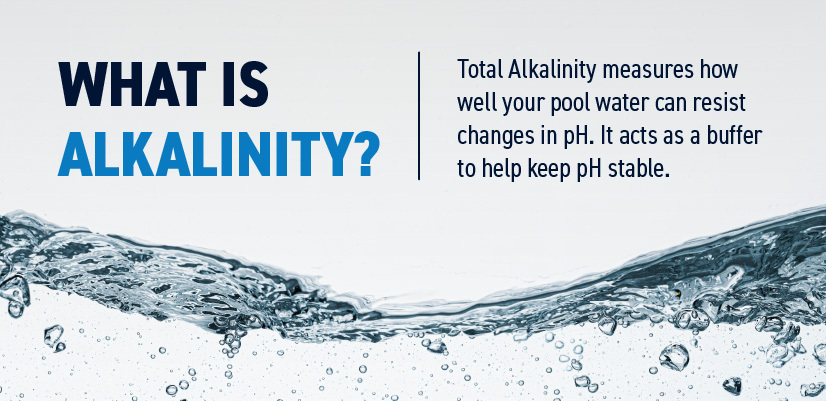
Alkalinity refers to the presence of alkaline substances such as bicarbonates and hydroxides in pool water. In simple terms, it measures the water’s ability to resist sudden changes in acidity. That is why alkalinity is often described as a buffer for pH.
Total alkalinity is measured in parts per million, or ppm, which is equal to one milligram per litre of water. For most swimming pools, the recommended alkalinity range is between 80 and 120 ppm.
If alkalinity falls below 80 ppm, the water can become too unstable and acidic. If it rises above 120 ppm, the water can become too alkaline. Both situations can create water quality problems, which is why it is important to keep alkalinity balanced.
Are Alkalinity And pH The Same Thing?
Many pool owners confuse alkalinity with pH, but they are not the same. They work closely together, which is why they are often discussed side by side, but they measure different things.
pH tells you how acidic or alkaline your pool water is on a scale of 1 to 14. The lower the number, the more acidic the water is. The higher the number, the more alkaline it is. Alkalinity, on the other hand, measures the concentration of alkaline substances in the water and the water’s ability to resist sudden pH changes.
A simple way to think about it is this: pH shows where the water sits right now, while alkalinity helps keep that pH stable. When alkalinity is out of range, pH often becomes more difficult to manage.
For example, bleach has a pH level of 13 and is very alkaline, lemon juice has a pH of 2 and is very acidic, and pure water sits at 7, which is neutral. While you do not need to understand all the chemistry in detail, it does help to know that monitoring alkalinity makes it much easier to maintain a healthy pH level in your pool.
When Should You Test Pool Water Alkalinity?
It is a good idea to test pool water alkalinity regularly as part of normal pool maintenance. As a general guide, testing at least twice a week is a sensible approach, especially during warmer months or periods of heavy use.
You should also test alkalinity levels when:
- many people have used the swimming pool
- there is a major change in the weather
- a rainstorm has occurred
- you add fresh water to the pool
- you begin an algae treatment
- the water becomes cloudy or the pH becomes unstable
How Can You Test Pool Water Alkalinity?
There are several ways to test swimming pool water alkalinity. The most common options are simple to use and suitable for regular pool care.
1. Test Strips
Using test strips is one of the easiest and most affordable ways to measure pool water alkalinity. To use them, submerge the strip in the pool water for a few seconds, remove it, and then allow the reagents to react. Once the colours develop, compare the strip to the colour chart on the packaging to determine the reading.
2. Liquid Testing Kits
Liquid testing kits are also commonly used and can provide accurate results when used properly. These kits generally require you to collect a water sample, add the included reagents, and compare the resulting colours to the colour chart in the kit. Many pool owners use these kits to test alkalinity, pH and chlorine levels as part of their regular maintenance routine.
No matter which testing method you use, it is important to follow the instructions carefully to get the most reliable reading.
What Are The Adverse Effects Of Low And High Alkalinity?
Let us look at the after-effects of an imbalance in your pool chemistry:
Negative Effects Of Low Alkalinity
When pool alkalinity is too low, the water becomes less stable and more prone to sharp pH swings. This can lead to:
- wear and tear of the pool surface
- greenish or discoloured pool water
- burning eyes and irritated skin
- greater difficulty maintaining balanced pool chemistry
Negative Effects Of High Alkalinity
When alkalinity is too high, it can also create several maintenance problems, including:
- cloudy or murky pool water
- a build-up of foreign materials or scale on pool surfaces
- high pH that is difficult to bring down
- reduced effectiveness of chlorine for sanitising
- clogging of filters and reduced water circulation
- staining and corrosion on pool equipment
While high alkalinity is often less immediately irritating than low alkalinity, it can still make ongoing maintenance harder and lead to higher long-term upkeep costs.
How Can You Raise The Alkalinity Level Of Your Pool?
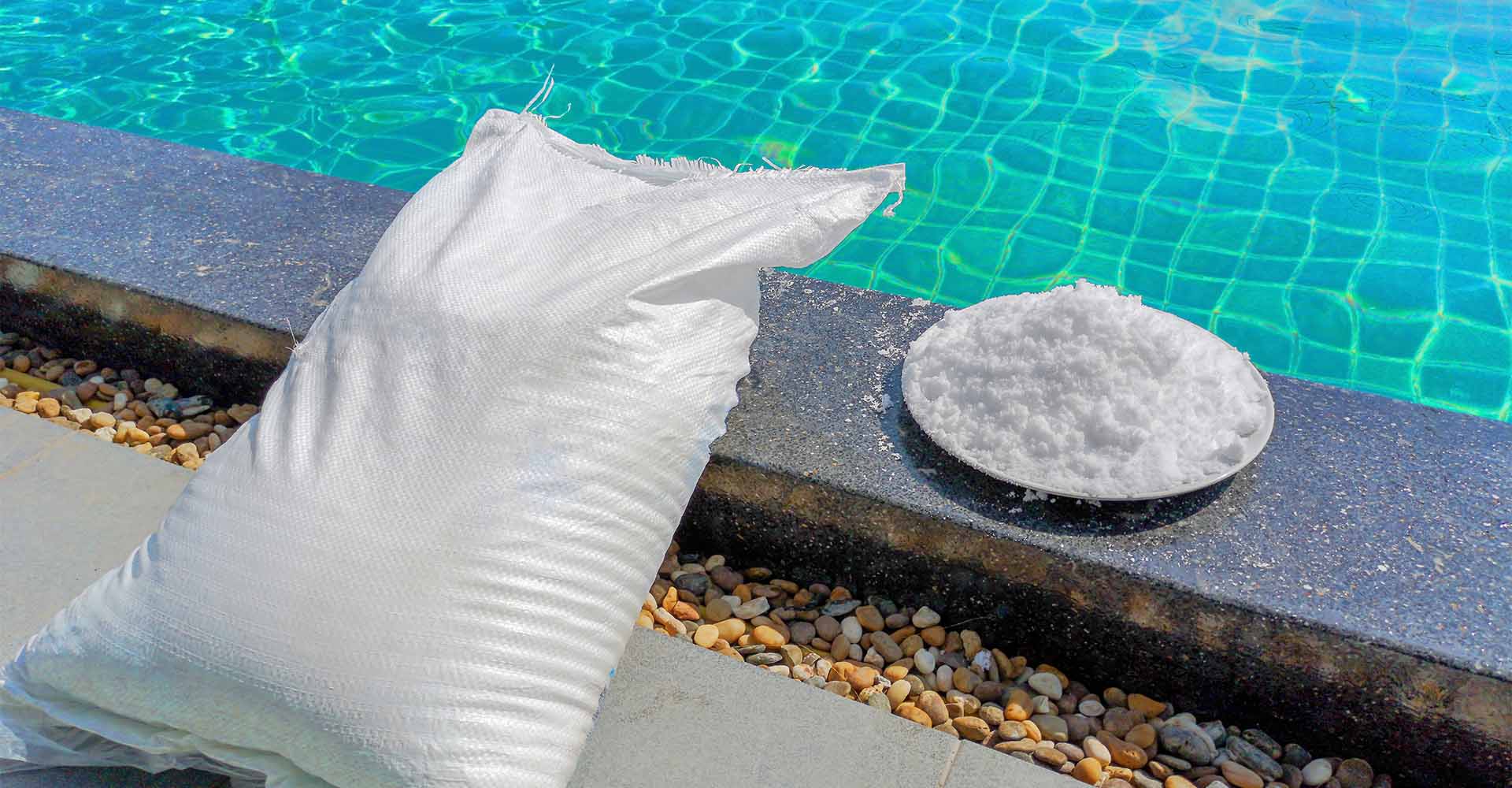
If your alkalinity level drops below the recommended range, sodium bicarbonate, commonly known as baking soda, is the most common way to raise it.
Test The Water
Use a pool testing kit or pH sensor to check the current alkalinity level of your water. If the level is below 80 ppm, it is time to begin adjusting it.
Buy Baking Soda
Baking soda is widely used to raise total alkalinity. The quantity you need will depend on the size of your pool and how low the alkalinity reading is. If you are unsure, your pool supplier can help guide you on the right amount.
Add The Right Quantity
Do not add the full amount all at once. It is better to begin with half to three-quarters of the estimated amount and then adjust gradually. Follow the package directions and distribute it as evenly as possible through the pool water.
Retest
Wait around six hours, and no more than twenty-four hours, before retesting the water. If the alkalinity level is still too low, you can repeat the process step by step until the water is back within the recommended range.
What If You Want To Bring Down The Alkalinity Level?
Lowering the alkalinity level in your pool is also straightforward, but it should be done carefully. The most common products used are dry acid or sodium bisulfate.
Turn on the water pump and make sure the pool water is circulating properly. Add the dry acid evenly across the pool and allow it to dissolve. Then monitor the pH and alkalinity regularly before deciding whether more product is needed.
Note: Be cautious with the amount of dry acid you use. Too much can damage the surface of your pool and throw other parts of the water chemistry out of balance.
Closing Thoughts
Maintaining the right balance of chemicals in your pool is an ongoing process. With every swim, rain event, top-up or introduction of oils, lotions, debris or leaf litter, your pool water chemistry can shift. That is why it is so important to keep an eye on both alkalinity and pH.
Once you understand how alkalinity works and test it regularly, it becomes much easier to keep your pool water clear, hygienic and comfortable to swim in. A balanced pool is not only better for swimmers, but also for the long-term condition of your pool surface and equipment.
If you are still unsure about how to keep your pool water healthy, get in touch with us. Our experienced pool builders have been installing and maintaining pools of different sizes for many years. We would be happy to be of service.
If you have any other pool-related inquiries, give us a call today!
Frequently Asked Questions About Pool Alkalinity
The recommended total alkalinity range for most swimming pools is 80 to 120 ppm.
No. pH measures how acidic or alkaline the water is, while alkalinity measures the water’s ability to resist sudden pH changes and helps keep pH stable.
Low alkalinity can be caused by heavy rain, excess use of chlorine tablets, too much dry acid, and contaminants such as urine and perspiration in the pool water.
High alkalinity can be caused by source water with high alkaline content, oils and lotions entering the pool, and chemical imbalance after heavy use or frequent shocking.
You can raise alkalinity by adding sodium bicarbonate, or baking soda, in measured amounts and then retesting the water after several hours.
You can lower alkalinity using dry acid or sodium bisulfate, added carefully while the pump is running and the water is circulating.